
Things to Do in Izumi(English version)


Izumi Wintering Habitat of Cranes
Izumi City is Japan’s largest wintering ground for cranes, and over 10,000 cranes migrate every year from mid-October spend the winter until around March of the following year.
The majority of these cranes are endangered species, including White-naped Crane and Hooded Crane.
It is said that approximately 40% of the world’s White-naped Cranes and approximately 90% of the world’s Hooded Cranes spend the winter in Izumi.
Other species that have been spotted include Common Crane, Sandhill Crane, Siberian Crane, Demoiselle Crane, and Red-crowned Crane. Of the fifteen crane species recognized worldwide, seven species and one hybrid (Hooded Crane) have been recorded migrating here.
Furthermore, since 1997, over 10,000 cranes have migrated here for 29 consecutive seasons.
The number and variety of cranes here are said to be the highest in Japan, and “Izumi Wintering Habitat of Cranes” has been designated a Special Natural Monument by the national government.
In November 2021, Izumi City was registered as a Ramsar Convention site as “Izumi Wintering Habitat of Cranes” since it meets four of the nine criteria for identifying wetlands of international importance.
In addition to cranes, Izumi City is also known as “treasure trove of wild birds”, with approximately 300 of the approximately 600 wild bird species sighted in Japan.
The city has a long history of caring and striving alongside cranes, including not only protecting the injured or weakened but erect the monument in memory of the spirit of cranes.
There were also people who fed the cranes even during the difficult times of post-war chaos.
When the “Kagoshima Crane Conservancy” was established in 1962, full-scale conservation efforts began, and in response, the number of cranes wintering here has increased.
While wetlands nationwide decreased between 1965 and 1975 due to residential development and other factors,
“Izumi Wintering Habitat of Cranes” were protected as rice paddies under domestic criteria that restrict the conversion of their habitat.
To protect this rich natural environment and pass it on to future generations, Izumi City formulated the ” Izumi Wintering Habitat of Cranes Conservation and Utilization Project ” in March 2022.
We are engaged in a variety of activities to promote Ramsar’s three pillars: “Conservation and Restoration,” “Wise Use,” and “Exchange and Learning.”
Specifically, setting up fences using natural materials (straw) to implement “Conservation and Restoration,” and conducting “Hometown Izumi Clean-up Campaign” (cleaning activities led by local residents).
In addition, activities to carry out “Wise Use”, training ecotourism guides and promoting local brand through the use of the Izumi Ramsar Label PR logo.
To promote “Exchange and Learning,” we provide lectures at local elementary and junior high schools, as well as museum lectures
As a result, local students conduct crane population surveys, as well as bus tours as Crane Guide Doctors (a guide group of local elementary and junior high school students).
We ask visitors who come and watch the cranes to contribute to the conservation of the wintering grounds, and those who contribute are loaned electric vehicles and binoculars.
The Environmental Conservation Fee are used for conservation and restoration of environment, finding new ways to display the cranes, and improving services for cooperating visitors.
In recent years, in preparation for the highly pathogenic avian-flu, Izumi City have been working with Ministry of the Environment, Kagoshima Prefecture, and Kagoshima University to conduct bird habitat surveys, fecal sampling surveys, patrols by observers, water sampling surveys of roosts, and surveys of dead wild birds.
In addition, in the event that cranes become infected with the highly pathogenic avian-flu, local government uses the conservation contributions to strengthen its quarantine measures, disinfecting road surfaces with sprinkler trucks and disinfecting vehicle tires at manned disinfection points.
We continue to protect the cranes while maintaining harmony between nature and local life, by feeding the cranes as a measure to prevent them from damaging agricultural business.
Through these activities, we aim to protect the environment in which the cranes live, as well as educating local children about the value of nature and foster a love of their hometown, so that it can be passed on to future generations.
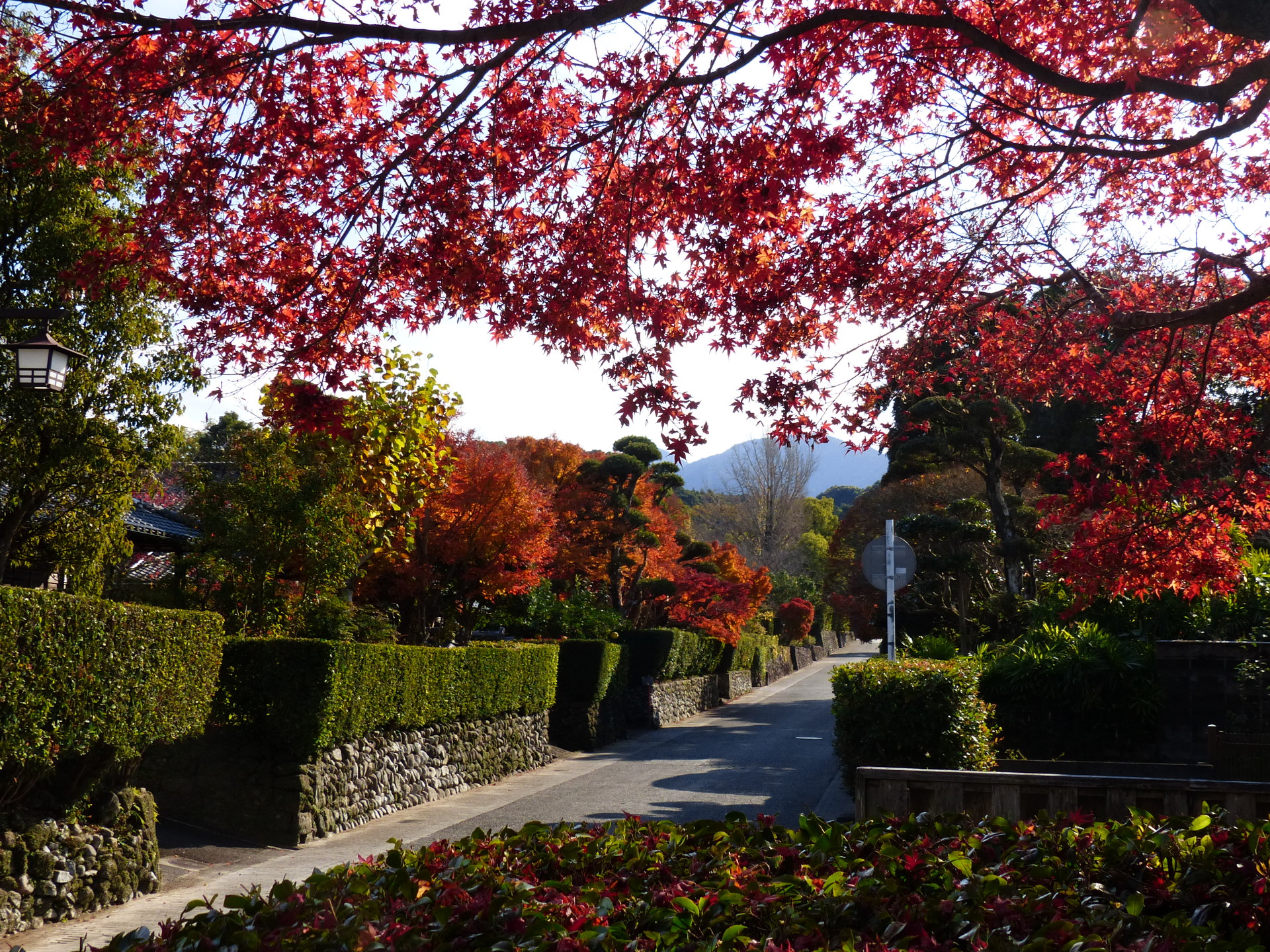
Izumi Fumoto Samurai Residences
Izumi City lies on the border with Higo Domain (present-day Kumamoto Prefecture), and was one of the most important bases for the defense of the Satsuma Domain (present-day Kagoshima Prefecture).
“Izumi Fumoto Samurai Residences”, once the largest cluster of Samurai residences in Satsuma Domain, still retains its streetscape of approximately 400 years ago, with stone walls, hedges, and Samurai gates.
Izumi Fumoto is home to two public Samurai residences, Saisho-tei and Takezoe-tei, as well as Izumi Fumoto History Museum, which are essential facilities for learning about Izumi City’s history.
Saisho-tei Residence,one of public samurai residences, retains features reminiscent of the lives of Samurai of the time, such as a place to practice archery in rainy weather, a hidden room, and a secret passageway leading from the hearth to the outside.
Other public Samurai residence, Takezoe Residence, has a structure unique to the Satsuma domain known as a two-building connected structure, and has kitchen, stables, and storehouse to resemble their original state.
The Izumi Fumoto History Museum is the base for sightseeing in Izumi Fumoto, displaying historical exhibitions from Izumi Fumoto.
You can learn about Izumi Fumoto through diorama model and VR videos that displays Izumi from about 400 years ago.
To experience this historically significant Izumi Fumoto even deeper, we recommend Kimono Dressing Activity, where you change into Kimono and stroll around town, or Oxcart Riding Activity which is unique to Izumi in Japan pulled by Japanese Black cattle.
Putting on a kimono and strolling through the beautiful streets of Izumi-Fumoto while being rocked in an ox-drawn carriage will make you feel as if you’ve traveled back in time.
Izumi-Fumoto is also home to RITA Izumi-Fumoto, a renovated Samurai residence that serves as a lodging facility, where you can spend a relaxing time immersing yourself in lives of Samurai of the time.
Preserving the Izumi-Fumoto Samurai Residences
The Izumi-Fumoto Samurai Residences have long been subjected by resident-led efforts to preserve this beautiful landscape, led by the Samurai Residence Preservation Society (Izumi-Fumoto Streetscape Preservation Society), a group of Samurai residence experts.
To support these preservation efforts by local residents, Izumi City designated Izumi-Fumoto area as a Preservation District for Groups of Traditional Buildings in 1995, and has been implementing the Traditional Building District criteria to preserve the townscape.
In following December, it was designated Important Preservation District for Groups of Traditional Buildings by the national government, and in May 2019, it was recognized as Japan Heritage Site.
In order to preserve Izumi Fumoto’s historic streetscape and pass it on to future generations in the best possible form, Izumi City formulated Izumi Fumoto Traditional Buildings Preservation District Utilization Project in 2006, establishing Construction and Repair Standards for Buildings.
Izumi City provides subsidies for a portion of construction and repair work that meets these standards.
To make these standards known to as many residents as possible, the Izumi Fumoto New Housing Guidelines were created in 2024, and are being disseminated in an easy-to-understand manner using diagrams.
But the streetscape is not the only thing that local residents have preserved.
The people of Izumi Fumoto have also passed down the Samurai mindset itself to future generations.
A prime example of this is the “Izumi Heko Shuyo Okite.”
-
The “Izumi Heko Shuyo Okite” are Bushido bible teaching young people to grow up strong, and its spirit remain deeply in the local Izumi community today.
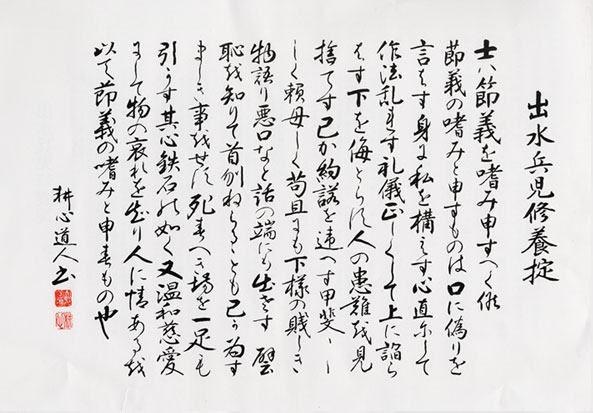
出水兵児修養掟_page-0001.jpg)
This Samurai Code preaches important lessons for people living today, and by teaching it to local children and helping them understand its meaning, it is being passed on to future generations.